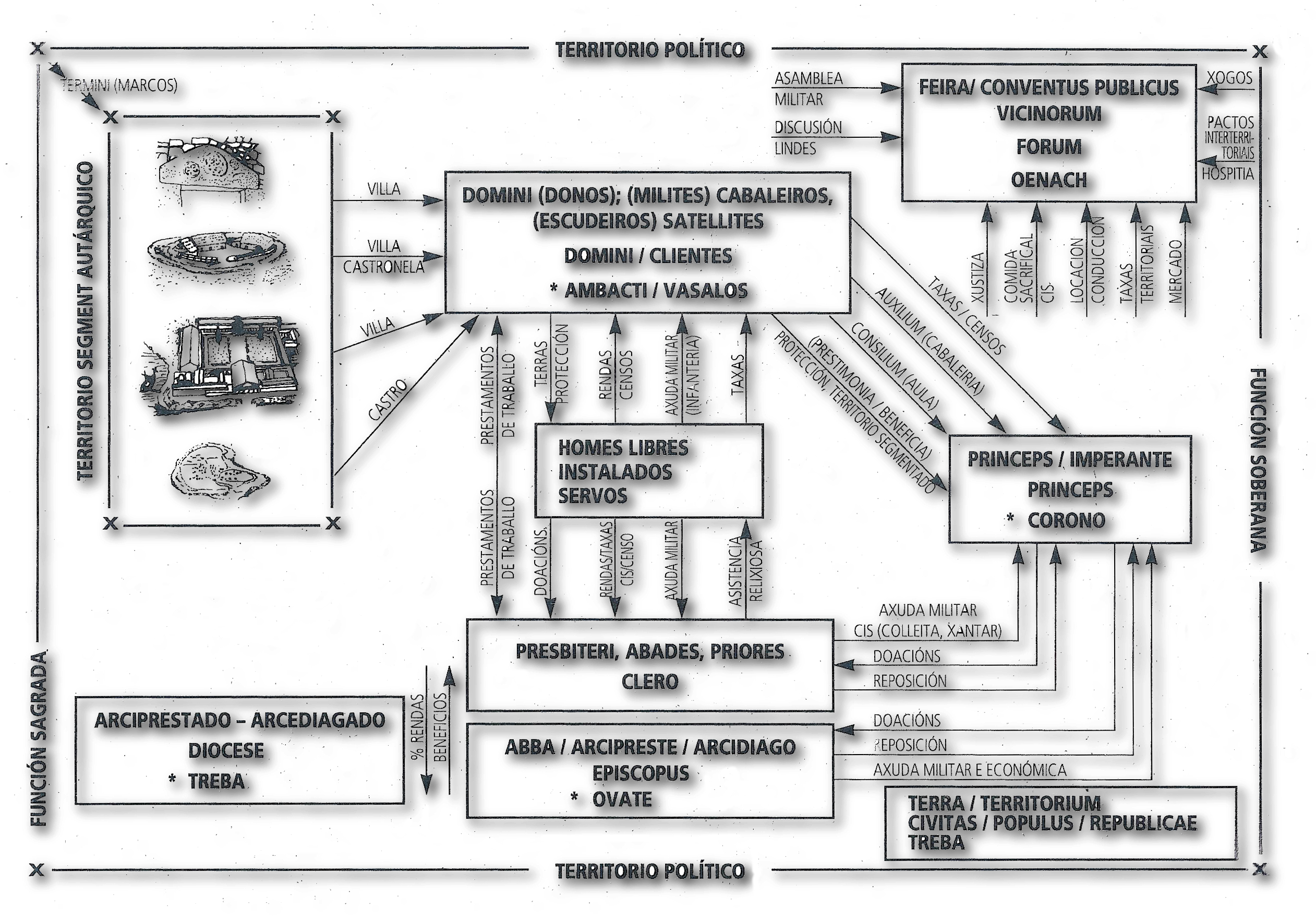
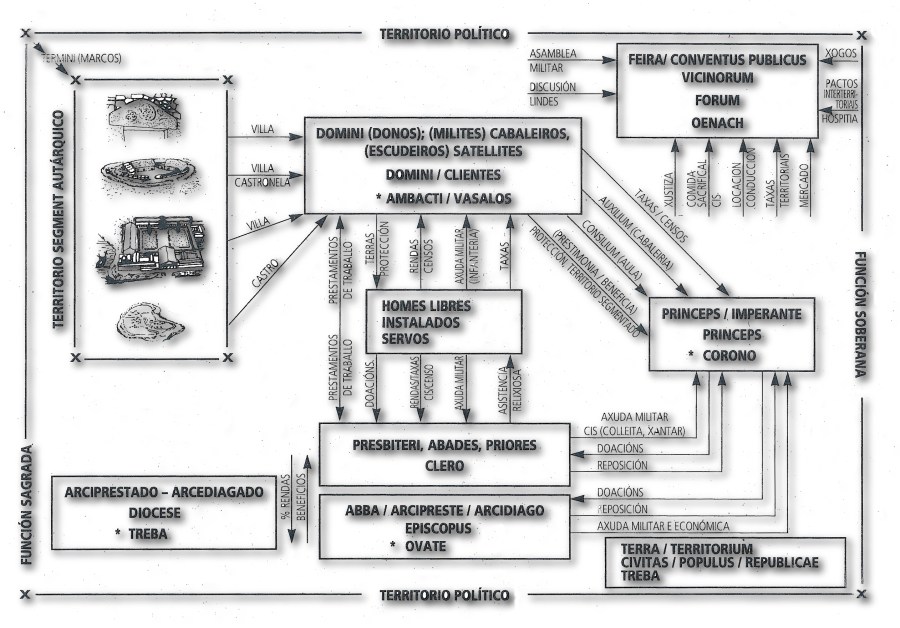
Since the dawn of the Bronze Age Celtic Europe is a mosaic of identical autonomous political territories we commonly call tribes and Romans called ciuitates / populi. Sharing a common structure, these tribes – as is Gallaecia- are known either in Europe (Pena 1992; Karl 2002) with words of domestic sovereignty: TREBA [TRIFU, TRIBE, etc.] and TOUDA [TEUTA, TOUTO, etc.] with a term alluding to the people, state or nation.
As in Ireland (MacCone 1990; Gibson 1995; Byrne 1971), Wales (Hubert2), Scotland (A.
Dogshon), continental Europe (Wens; Halselgrove) and the Nordic countries (Kristiansen), the ancient Gallaecia configured itself as a succession of political territories that probably emerged at an early stage. In Treba y Territorium (USC 2004), in a long term study (1987-2010) of a Galician shrine in Narão (Northwest Galiza), this author notes a Neolithic origin of the Treba3.
In 1941 Marc Bloch noted rural areas in primitive Europe ruled by hereditary princes and a common, well-developed institutional framework. He later identified common Indo-European Celtic and Germanic institutions, with their service obligations and hierarchical relationship often called feudal, tracking them as far back as the second millennium BCE. “There is sufficient evidence”- said Stuart Piggot “to suggest that the model of society demanded by Bloch may in fact be very archaic and characteristic of barbarian Europe” (Piggot 1965: 259- 260)
 Narón, Fidalga Cidade